
5 Tips On How To Capture Christmas
5 Essential Tips for Capturing Christmas: More Than Just Photos
The spirit of Christmas is a fleeting, joyous phenomenon, marked by twinkling lights, the aroma of gingerbread, and the warmth of shared moments. While digital photographs have become the primary medium for preserving these memories, truly capturing Christmas involves more than simply pointing and clicking. It’s about engaging with the season, understanding its nuances, and employing techniques that translate that magic into tangible keepsakes. This article delves into five key strategies to elevate your Christmas captures, ensuring you preserve not just images, but the very essence of this cherished holiday.
1. Embrace the Ambiance: Mastering Low-Light and Festive Lighting Photography
Christmas is synonymous with low-light conditions, illuminated by a symphony of artificial lights. This presents both challenges and incredible opportunities for photographers. The ambient glow of fairy lights, the flickering flames of a fireplace, and the soft radiance of a Christmas tree create a unique atmosphere that traditional daylight photography struggles to replicate. To effectively capture this, understanding your camera’s capabilities and employing specific techniques is paramount.
Understanding Your Camera’s ISO: Your camera’s ISO setting controls its sensitivity to light. In low-light Christmas scenarios, you’ll often need to increase your ISO. However, be mindful of digital noise, which is the grainy appearance that can result from high ISO settings. Modern cameras have significantly improved their low-light performance, but it’s still a trade-off. Experiment with your camera to find the highest ISO setting that produces acceptable results for your desired output. Consider shooting in RAW format, which provides greater flexibility in post-processing to reduce noise without sacrificing image detail.
Shutter Speed for Motion and Sharpness: Shutter speed is another crucial element. A slower shutter speed will allow more light to enter the sensor, which is beneficial in low light. However, it also increases the risk of motion blur. If you’re photographing a still scene, like a beautifully decorated tree, a slower shutter speed combined with a tripod can result in stunningly sharp images with rich detail. If you intend to capture movement, such as children opening gifts or dancing around the tree, you’ll need to balance shutter speed with aperture and ISO. A faster shutter speed will freeze action but requires more light. Conversely, a slightly slower shutter speed can introduce a sense of dynamic movement, capturing the energy of the moment. Experimentation is key to finding the sweet spot.
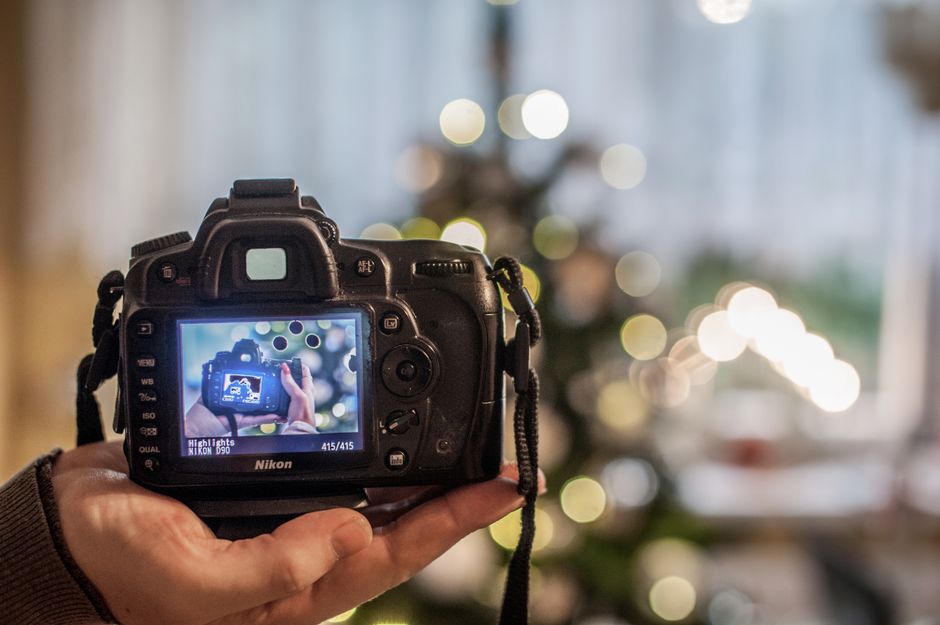
Aperture for Depth of Field and Bokeh: The aperture of your lens controls the amount of light entering and the depth of field – how much of your image is in focus. A wider aperture (lower f-number, e.g., f/1.8, f/2.8) allows more light and creates a shallow depth of field, which can beautifully isolate your subject against a soft, blurred background. This is particularly effective for capturing close-ups of ornaments or portraits of loved ones with the festive lights creating a pleasing bokeh effect – those dreamy, circular highlights. A narrower aperture (higher f-number, e.g., f/8, f/11) will bring more of the scene into focus, ideal for capturing the entire Christmas tree or a bustling family gathering.
White Balance for Accurate Colors: Artificial Christmas lights often have a distinct color temperature, which can cast an unnatural hue on your photos. Your camera’s white balance setting helps to correct this. Auto white balance can sometimes struggle with mixed lighting. Experiment with presets like "Tungsten," "Fluorescent," or "Custom white balance" by photographing a neutral gray card or a white object under the festive lights. If shooting in RAW, you have the most flexibility to adjust white balance accurately in post-processing. The goal is to ensure that the reds of the ornaments remain vibrant, the greens of the tree are true, and skin tones appear natural.
Leveraging the Light Sources: Don’t just photograph in the light; photograph with the light. Position your subjects so that the Christmas lights are behind or to the side of them, creating rim lighting that separates them from the background and adds a magical glow. Capture the reflections on ornaments, the sparkle of tinsel, and the subtle interplay of light and shadow on faces. Consider using external light sources like a small LED panel or a speedlight bounced off a ceiling or wall to fill in shadows and create more balanced exposures, especially for portraits. However, be judicious; often, the charm of Christmas lies in its natural, diffused light.
2. Storytelling Through Composition: Beyond the Snapshot
While a quick snap of the tree might suffice for a casual update, truly capturing Christmas requires a narrative. This involves thoughtful composition, moving beyond simply placing your subject in the center of the frame. Compositional techniques guide the viewer’s eye, create visual interest, and convey emotion, transforming a collection of photos into a cohesive story.
Rule of Thirds and Beyond: The rule of thirds is a fundamental compositional guideline that suggests dividing your image into nine equal parts by two horizontal and two vertical lines. Placing key elements of your image along these lines or at their intersections can create a more balanced and visually appealing photograph. For Christmas scenes, consider placing the Christmas tree slightly off-center, or positioning a child opening a gift at one of the intersecting points. Don’t be afraid to break this rule once you understand it; sometimes, a perfectly centered subject can be incredibly impactful, especially for symmetrical scenes like a perfectly adorned mantelpiece.
Leading Lines and Framing: Leading lines are natural or artificial lines within an image that draw the viewer’s eye towards the main subject. In Christmas photography, these can be the branches of the tree leading to the star at the top, the path of fairy lights across a wall, or even the arms of family members reaching for a gift. Framing involves using elements within the scene to create a natural frame around your subject. This could be the archway of a doorway, the branches of a wreath, or even the hands of a loved one cupping a candle. Framing adds depth and context, making the viewer feel more immersed in the scene.
Perspective and Angles: Don’t always shoot from eye level. Experiment with different perspectives to add dynamism and interest. Get down low to capture a child’s wide-eyed wonder as they look at the presents. Shoot from above to showcase the layout of a festive meal or the arrangement of gifts under the tree. Dutch angles (tilting your camera) can add a sense of drama or disorientation, but use them sparingly and intentionally. Capturing the Christmas experience from unusual vantage points can reveal details and perspectives that are often overlooked.
Capturing Emotion and Interaction: The most compelling Christmas captures are those that convey emotion and highlight interaction. Focus on genuine smiles, shared laughter, a comforting hug, or the quiet anticipation before a gift is opened. These are the moments that define the holiday’s spirit. Get close to your subjects to capture their expressions. Be patient and wait for these fleeting moments to unfold naturally. Encourage interaction – ask siblings to look at each other, or prompt parents to engage with their children. These candid, unscripted moments are often the most treasured.
The Power of Negative Space: Negative space is the area around and between your subject. It’s not empty space; it’s intentional. Using negative space can help to isolate your subject, create a sense of calm, and emphasize the importance of the focal point. A single ornament against a softly blurred background, with ample negative space, can feel more profound than a cluttered shot. Consider how the dark, unlit corners of a room can actually enhance the glow of the Christmas lights by providing contrast.
3. Beyond the Still Image: Harnessing the Power of Video and Time-Lapse
While photographs are the bedrock of memory preservation, video and time-lapse sequences offer a dimension of capturing Christmas that stills cannot replicate. They bring movement, sound, and the passage of time into your captures, providing a richer, more immersive experience.
Capturing the "Living" Moments with Video: Video allows you to record the sounds of Christmas – carols playing softly, the crackle of the fireplace, the excited chatter of children, the clinking of glasses during a toast. It preserves the movement of flickering candles, the unwrapping of presents, and the joy of a dance around the tree. When shooting video, focus on storytelling. Instead of just recording a static scene, aim to capture the flow of events. Think about creating short vignettes: the preparation of a festive meal, the journey to church, the arrival of guests.
Stabilization is Key: Shaky video footage can be distracting and unprofessional. Utilize a tripod, gimbal, or even lean against a stable surface to keep your camera steady. Many smartphones have excellent built-in image stabilization, which can significantly improve handheld video quality. When editing, consider using stabilization tools if your footage is still a bit wobbly.
Audio is Half the Story: Don’t neglect the audio. The ambient sounds of Christmas are as important as the visuals. If your camera or phone has a decent microphone, use it. For higher quality audio, consider an external microphone. Capturing the laughter, conversations, and music will add a significant layer of immersion to your video memories.
Time-Lapse: Compressing Time and Revealing Change: Time-lapse photography is a fantastic way to capture the transformation of a space or the progression of an event. Think about setting up your camera to capture the gradual illumination of the Christmas tree as you add more lights, or the building anticipation as gifts are stacked under it. A time-lapse of the snowfall outside your window, or the bustling activity of a Christmas market, can be mesmerizing.
Planning Your Time-Lapse: For time-lapse, you’ll need a tripod to keep your camera perfectly still throughout the recording. Consider the interval between shots – a shorter interval will create smoother motion, while a longer interval will highlight more dramatic changes. Most cameras and smartphones have a dedicated time-lapse mode. Experiment with different durations and intervals to find what works best for your chosen subject.
Creative Applications for Video and Time-Lapse: Beyond the obvious, consider creative applications. A "day in the life" video montage, edited together with music, can be a powerful way to document the entire Christmas experience. A time-lapse of a family decorating the tree can be a fun and engaging way to showcase the creative process. Even short, looping videos of the fireplace or twinkling lights can be used as subtle, atmospheric background elements on digital displays or in slideshows.
4. Embracing the Imperfect: Authentic Moments and Candid Captures
In our pursuit of perfection, we can sometimes miss the beauty of the unscripted, the slightly askew, and the genuinely human. Christmas is a time of shared experiences, and these often involve a degree of delightful chaos. Embracing imperfection leads to more authentic and relatable captures.
The Beauty of the Unposed: While posed portraits have their place, some of the most cherished Christmas memories are captured in candid moments. A child’s messy face after sneaking a cookie, a sibling squabble over a toy, or the sleepy embrace of a parent and child on Christmas morning – these are the moments that tell a story of real life and genuine emotion. Be ready to capture these moments as they happen, without intervention.
Focus on Genuine Reactions: Instead of asking everyone to smile for the camera, try to capture their genuine reactions. The look of surprise on someone’s face as they open a long-desired gift, the quiet contemplation of a child gazing at the tree, or the shared laughter over a silly anecdote – these are the powerful emotional cues that make your captures resonate.
The "Messy" is Part of the Charm: Don’t shy away from the "mess" of Christmas. The discarded wrapping paper, the half-eaten gingerbread cookies, the scattered toys – these are all part of the festive narrative. These elements add context and a sense of lived experience to your photographs. A well-composed shot of a festive table laden with food, even if slightly disheveled, can be far more evocative than a sterile, perfectly arranged scene.
Don’t Be Afraid of Grain or Imperfections: In the pursuit of perfect clarity, sometimes the character of a photograph can be lost. Embrace the natural grain that can appear in low-light situations, or the subtle imperfections that reveal the authentic nature of the moment. In post-processing, you can even choose to enhance or simulate certain textures that add to the nostalgic feel of your Christmas captures.
Letting Go of Control: This is perhaps the most important aspect of embracing imperfection. Let go of the need to control every element. Allow for spontaneity. The most beautiful Christmas moments often unfold organically, and your ability to be present and ready to capture them, without fuss, will result in the most meaningful memories.
5. Post-Processing and Presentation: Bringing Your Captures to Life
The capture is only the first step. Post-processing and thoughtful presentation are crucial for transforming your raw images and videos into compelling narratives that truly capture the essence of Christmas. This stage allows you to enhance the mood, refine the details, and share your memories in a way that resonates.
Essential Editing Tools: Whether you use professional software like Adobe Lightroom and Photoshop, or user-friendly mobile apps, basic editing can make a significant difference. For photographs, focus on:
- Exposure and Contrast: Adjusting these can bring out the details in shadows and highlights, ensuring your festive lights don’t blow out and your darker areas aren’t too muddy.
- White Balance: As mentioned earlier, fine-tuning white balance is critical for accurate and appealing colors.
- Color Saturation and Vibrancy: Enhance the rich reds of baubles, the deep greens of the tree, and the warm tones of candlelight without making the image look unnatural.
- Sharpening: Apply a subtle sharpening to bring out the details, especially in textures like fabric or ornaments.
- Noise Reduction: If you’ve shot at a higher ISO, judiciously apply noise reduction to clean up graininess.
For video, editing involves:
- Color Correction and Grading: Similar to photos, adjust colors to enhance the festive mood.
- Cutting and Sequencing: Create a narrative flow by selecting the best clips and arranging them logically.
- Adding Music and Sound Effects: Choose music that complements the mood of your video.
- Transitions and Text Overlays: Use subtle transitions and add text for titles or captions.
Creating a Cohesive Visual Story: Think about how your individual captures will work together. Develop a consistent editing style across your photos and videos to create a unified look and feel. This could mean a slightly warm tone, a touch of vintage feel, or a vibrant and cheerful aesthetic.
Presentation Matters: How you share your Christmas captures can significantly impact how they are perceived.
- Photo Albums and Scrapbooks: The tactile experience of flipping through a physical album or a beautifully crafted scrapbook is irreplaceable. Include journaling, ticket stubs, and other mementos to add depth.
- Digital Slideshows and Montages: Create engaging slideshows with music for family gatherings or to share online.
- Social Media and Online Galleries: Share your best shots on platforms like Instagram or Flickr, using relevant hashtags to increase visibility.
- Printed Wall Art: Select your most impactful images and have them professionally printed and framed for lasting display. Consider canvas prints, metal prints, or traditional framed photographs.
- Personalized Christmas Cards: Use your own photographs to create unique and heartfelt Christmas cards.
The Enduring Power of Your Captures: By employing these five tips – embracing ambiance, mastering composition, harnessing the power of video, valuing authenticity, and dedicating time to post-processing and presentation – you can move beyond simply documenting Christmas to truly capturing its spirit. These enhanced captures will become cherished heirlooms, bringing the warmth, joy, and magic of the holiday season to life for years to come.
